Descript taught a generation of podcasters to edit video like a document: delete a word in the transcript and it disappears from the video. Its agent, Underlord, cuts raw recordings into shape, and Descript also records your screen and remote guests. For talk-driven video content it is still the reference point.
But its Trustpilot score is 2.4 from 301 reviews, and paid plans cap media hours: 10 a month on Hobbyist, 30 on Creator and 40 on Business. The right choice for podcasters differs from the right choice for YouTube tutorials, so the 15 tools below are grouped by use case.
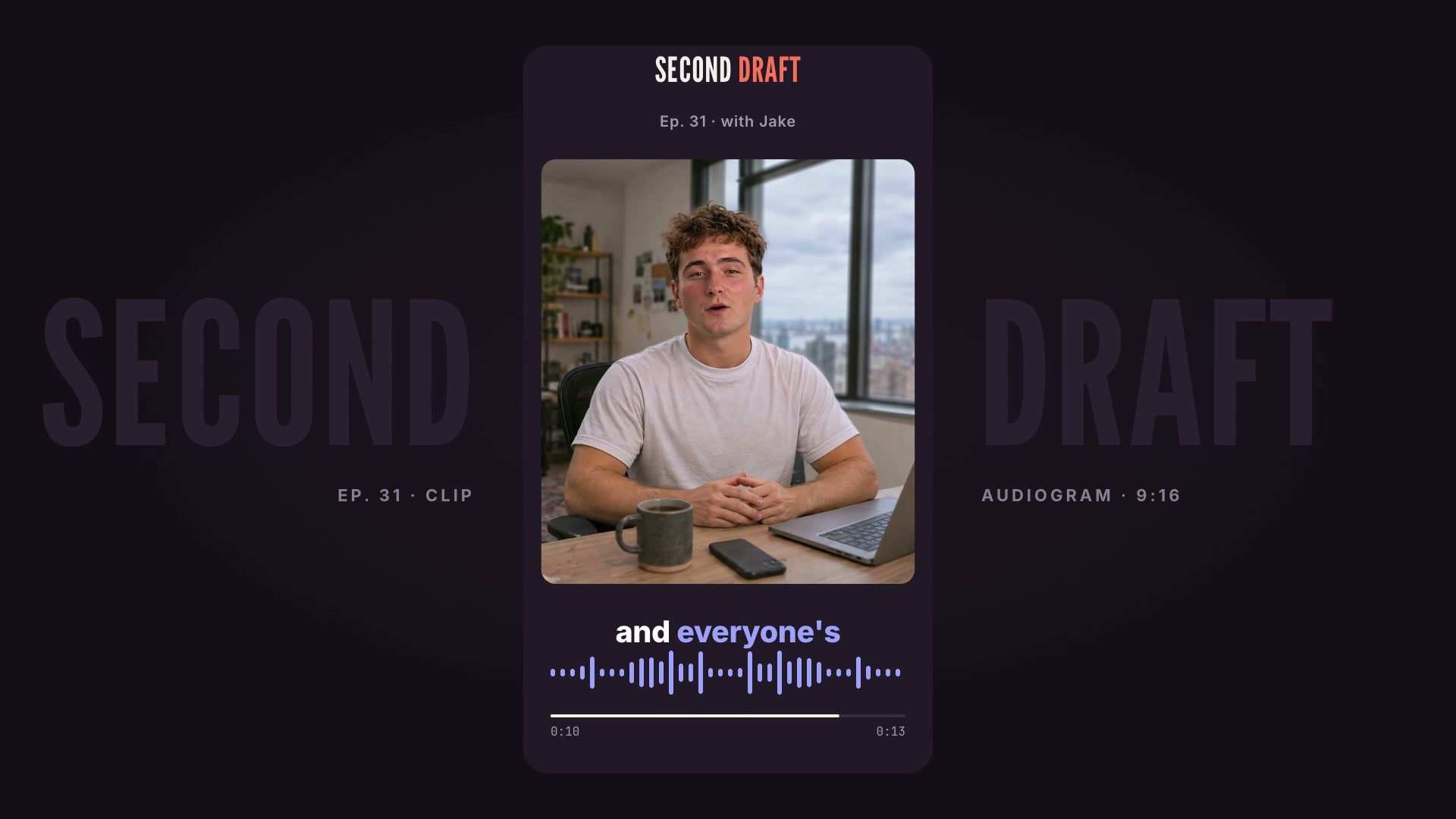
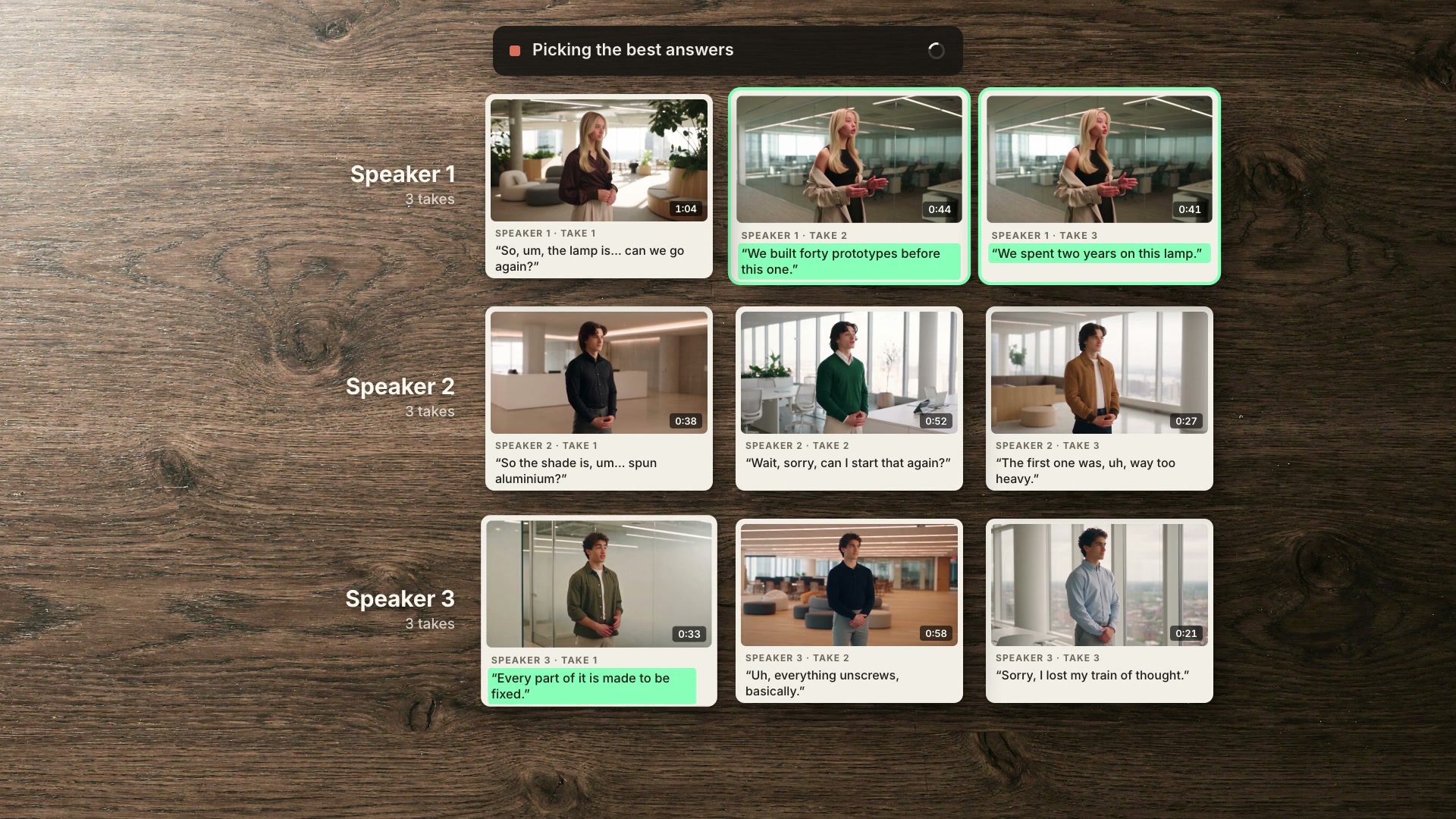
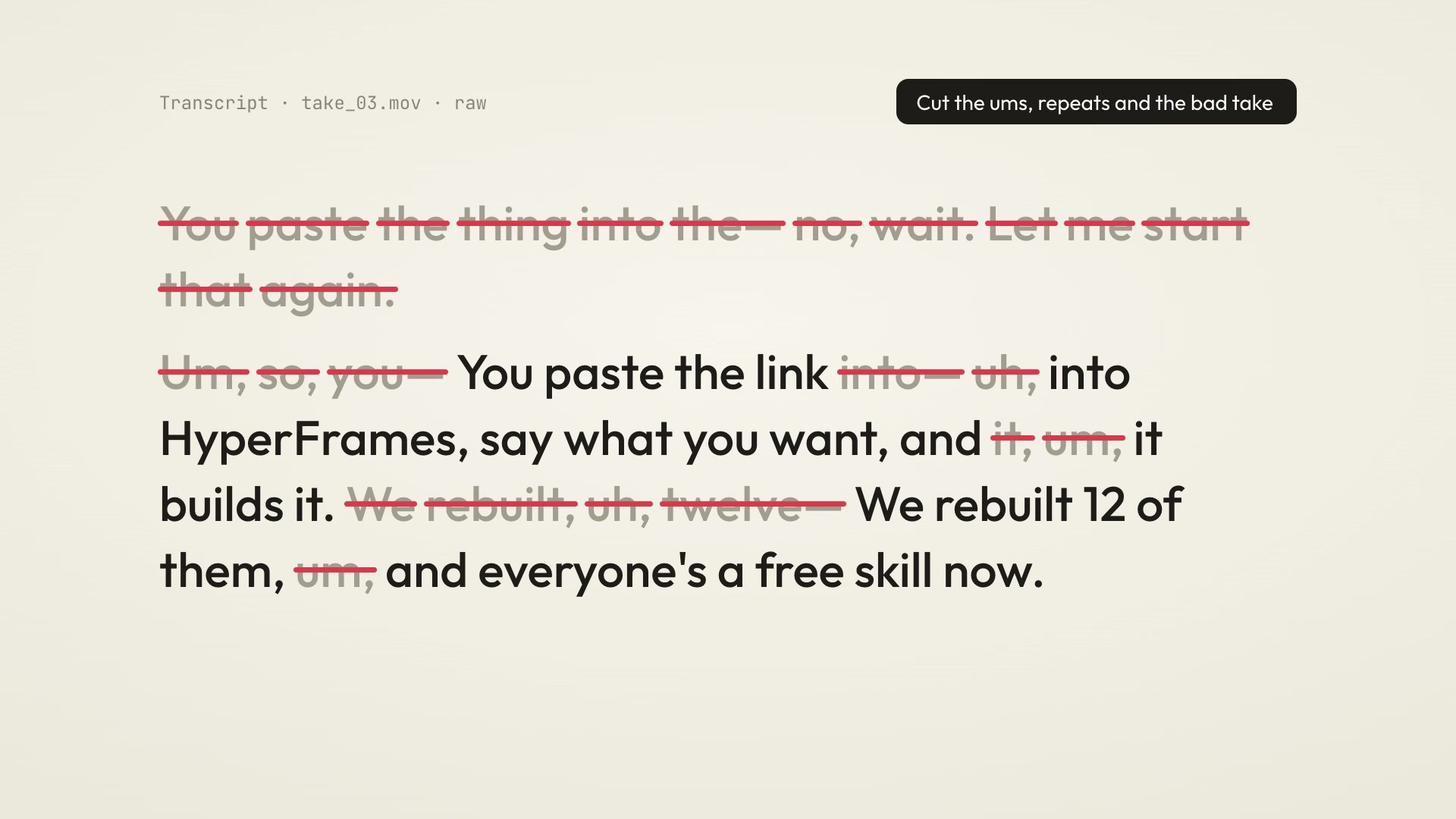
A flat raw take becomes a paced edit with cuts, a punch-in, captions and a title. Made with HyperFrames for this page.
Why look for a Descript alternative?
These are the reasons people give for leaving Descript, from its own pricing page and from public reviews read in November 2026:
Media-hour caps
Every plan meters the footage you bring in, so each hour of transcription counts: 1 hour a month on Free (at 720p), 10 on Hobbyist ($24 a month, or $16 billed yearly), 30 on Creator ($35, or $24 yearly) and 40 on Business ($65, or $50 yearly).
AI credits spent on weak results
Underlord runs on a separate credit allowance (400 a month on Hobbyist, 800 on Creator). One Trustpilot reviewer in October 2026 burned through 800 credits trying to clean up filler pauses on a single short reel.
Bugs and sync problems
Two recent Trustpilot reviewers describe edits that don't land where they should: one deleted the front of a scene and saw the end of the timeline cut instead (November 2026), another got AI edits out of line with the voiceover (September 2026).
Billing and cancellation
One Trustpilot reviewer (September 2026) says cancelling is extremely difficult, and another had to fight for a refund they qualified for.
Talk only, in our view
Descript is built around the spoken word. When a video needs designed motion graphics, charts, branded titles or a vertical cut with real framing, you'll often finish it somewhere else. That is our judgment, not a review quote.
Quick comparison: the best Descript alternatives
Fifteen alternatives at a glance, with Descript last for reference.
Tool | Best for | Our rating | Free plan | Starting price |
|---|---|---|---|---|
HyperFrames | Editing by transcript, by asking, and multicam podcasts | 4.7/5 | Yes, unlimited local exports | Free to start |
ChatCut | Chat edits on a pro-style timeline | 4.3/5 | Yes, unlimited local export | $25/mo list |
Palmier Pro | An open-source Mac editor your coding agent drives | 4.1/5 | Yes, no generation credits | $49/mo list |
VEED | Subtitled social videos in the browser | 4.1/5 | Yes, watermark | $25/mo per editor |
Riverside | Recording remote guests in studio quality | 4.2/5 | No, 14-day trial | $35/mo |
Async (formerly Podcastle) | Chat editing plus a podcast studio | 4.0/5 | Yes | $19.99/mo |
Zencastr | Free remote recording and hosting | 4.2/5 | Yes, fully free | Free |
Gling | Removing bad takes for YouTubers | 4.2/5 | Yes, 1 hr/mo, watermark | $20/mo |
TimeBolt | Fast desktop jump cuts with no credits | 4.2/5 | Yes, watermark | $17/mo or $347 once |
Adobe Premiere | Text-based editing in the industry standard | 3.8/5 | No, 7-day trial | $22.99/mo (annual) |
DaVinci Resolve | Free pro editing, colour and audio | 4.0/5 | Yes, UHD, no watermark | Free; Studio $295 once |
Reduct | Searching and cutting hours of transcribed footage | 3.8/5 | No, 14-day trial | $15/mo per editor |
OpusClip | Ranked clips from long episodes | 4.2/5 | Yes, 60 credits/mo, watermark | $15/mo |
CapCut | Free phone and desktop editing for trends | 4.0/5 | Yes | $19.99/mo |
Camtasia | Software tutorials and training | 3.6/5 | Yes, watermark | $179.88/yr (no watermark) |
Descript (for reference) | Editing video by editing the transcript | Not rated | Yes, 1 hr/mo, 720p | $24/mo |
Ratings average our three scores (fit, ease of use, value); see How we compared. Monthly list prices on 26 November 2026; Descript shows yearly prices by default.
Why trust us? HeyGen makes HyperFrames and publishes this page, so we compete with the tools below. Every rival's price, plan and feature comes from its own pricing page, help center or changelog, read on 25 and 26 November 2026. User complaints are quoted from public review sites and linked in How we checked. HyperFrames claims come from its pricing page and from the Studio app's current build. Where a rival is the better pick, we say so.
Clean up your next episode free
Best all-around Descript alternatives
Tools that do most of what Descript does for talk-driven videos: transcript or chat editing, cleanup, captions and export. The difference is what happens after the cut.
#1 HyperFrames: Best for editing by transcript, by asking, and multicam podcasts
From HeyGen's launch post: a multicam podcast imported into HyperFrames Studio, every um and repeat cut from the script.
Our rating: 4.7/5. Fit for this job 4.7/5, ease of use 4.5/5, value for money 4.9/5.
Descript made editing talk feel like editing a document, and for that habit it is still the reference. It stops in two places: the hours you can bring in are metered every month, and when Underlord misses, you pay credits for the try and then fix the cut yourself. In HyperFrames Studio you drop in the recording and say what you want: the ums, long pauses and retakes go, every word gets a caption, and the cut follows whoever is talking. Then point at one word, shot or caption and only that part changes, while the rest of the edit stays as you approved it. It's free to start, with no media-hour cap and no watermark on your computer.
Three ways into the same edit stay in step. The Script tab sits beside the timeline: delete a sentence and the video is cut, restore it and it comes back. The AI agent takes plain requests such as "cut every um and repeat" or "tighten the pauses but keep the one before the punchline". And the timeline is there for the frame-level trim a transcript can't express.
For podcasts, the multicam edit lines up every camera by sound, cuts to whoever is speaking, and writes per-speaker captions and show notes. Noise clean-up runs on your own computer, it imports Final Cut and Riverside XML, and word-by-word animated captions come in dozens of caption styles. Ask for vertical clips from the finished episode and the speaker stays in frame.
Standout feature: Change one thing, keep the rest: point at any word, shot or caption and only that part changes, whether you asked the agent, cut the transcript or trimmed the timeline.
What's the difference between HyperFrames and Descript? Descript edits by transcript with an AI agent, inside media-hour caps. HyperFrames Studio edits by transcript, by asking an AI agent or on the timeline, cuts multicam podcasts to the speaker, adds motion graphics, and has no media-hour cap on your computer.
HyperFrames pros:
- Free to start, with no media-hour cap and no watermark on your computer
- The agent does the edit: ums, pauses, retakes, captions and speaker cuts in one pass
- Change one word, shot or caption and the rest stays as you approved it
- Multicam podcast edit with per-speaker captions and show notes
HyperFrames cons:
- No screen recorder: record in Riverside, Zencastr, Zoom or your camera app, then bring the files in
- No multi-network scheduler: you post the files yourself (only stream clips post themselves, to YouTube)
Pricing: Free to start: a free download for Mac, Windows and Linux, or start in your browser, with exports on your computer and no watermark.
Who it's for: Podcasters, YouTubers and teams who film talk every week and want the edit done for them, then change one line without redoing the rest.
Choose HyperFrames if: you edit talk-driven videos or podcasts and want transcript editing plus an agent that finishes the edit, without a monthly hour meter.
What's new in HyperFrames: The Script tab (edit by transcript, cut and put back) and Edit my footage (one-pass cleanup of a recording) are on in every current Studio app build, as of November 2026.
Available for: Mac, Windows and Linux (the Studio app), the web, and inside Claude, ChatGPT and Grok through the HyperFrames connector
Shoot it, say it, or show it. HyperFrames makes the video. Bring your footage, describe any motion graphic or format, or paste a video you love.
Edit your next episode free
#2 ChatCut: Best for chat edits on a pro-style timeline
Our rating: 4.3/5. Fit for this job 4.2/5, ease of use 4.4/5, value for money 4.2/5.
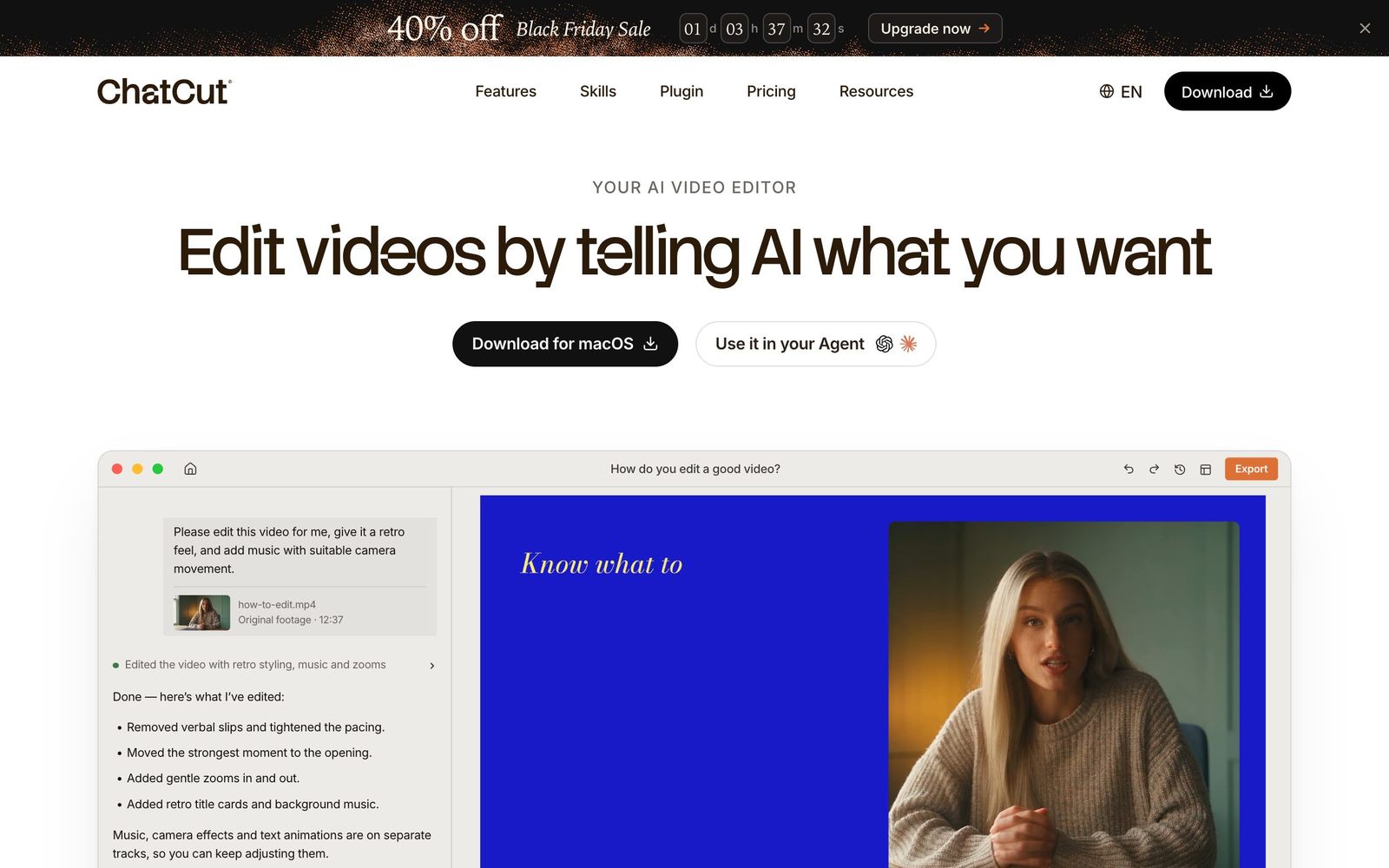
ChatCut is the closest thing to Underlord without the transcript-first layout. You describe the edit in chat ("remove the dead air", "add captions", "make three shorts from this") and the result lands on a real timeline you can change by hand, with 100+ one-click skills for speech cleanup, captions, shorts and translation.
It runs as a plugin inside ChatGPT, Codex, Claude Code and Cursor, and editing through those agents spends no ChatCut credits. It exports XML to Resolve, Premiere, Final Cut Pro and CapCut.
Standout feature: Edits you ask for in chat land on a real timeline you can adjust, and editing through Claude Code or Codex spends no ChatCut credits.
What's the difference between ChatCut and Descript? ChatCut is chat-first and puts every edit on a timeline. Descript is transcript-first, records remote guests and screens, and meters media hours.
ChatCut pros:
- Chat edits on an editable timeline
- 100+ one-click skills such as speech cleanup, captions and shorts
- XML export to Resolve, Premiere, Final Cut and CapCut
- Plugins for ChatGPT, Codex, Claude Code and Cursor
ChatCut cons:
- Generation spends credits even through outside agents
- One of its 3 Trustpilot reviews (November 2026) says limits keep moving, such as 4K export now needing Plus
Pricing: Free plan with signup credits, the full editor and unlimited local export. Starter lists at $25 a month; a Black Friday sale showed $21 a month billed yearly on 25 November 2026.
Who it's for: Editors who would rather ask than scrub, and who want a timeline they can still drag by hand.
Choose ChatCut over Descript if: you prefer asking to editing text, and want to hand the cut to Resolve or Premiere later.
What's new in ChatCut: ChatCut Desktop launched on Product Hunt on 26 August 2026, after the July launch inside ChatGPT, desktop and web.
Available for: Web, Mac, Windows, and plugins for ChatGPT, Codex, Claude Code and Cursor
#3 Palmier Pro: Best for an open-source Mac editor your coding agent drives
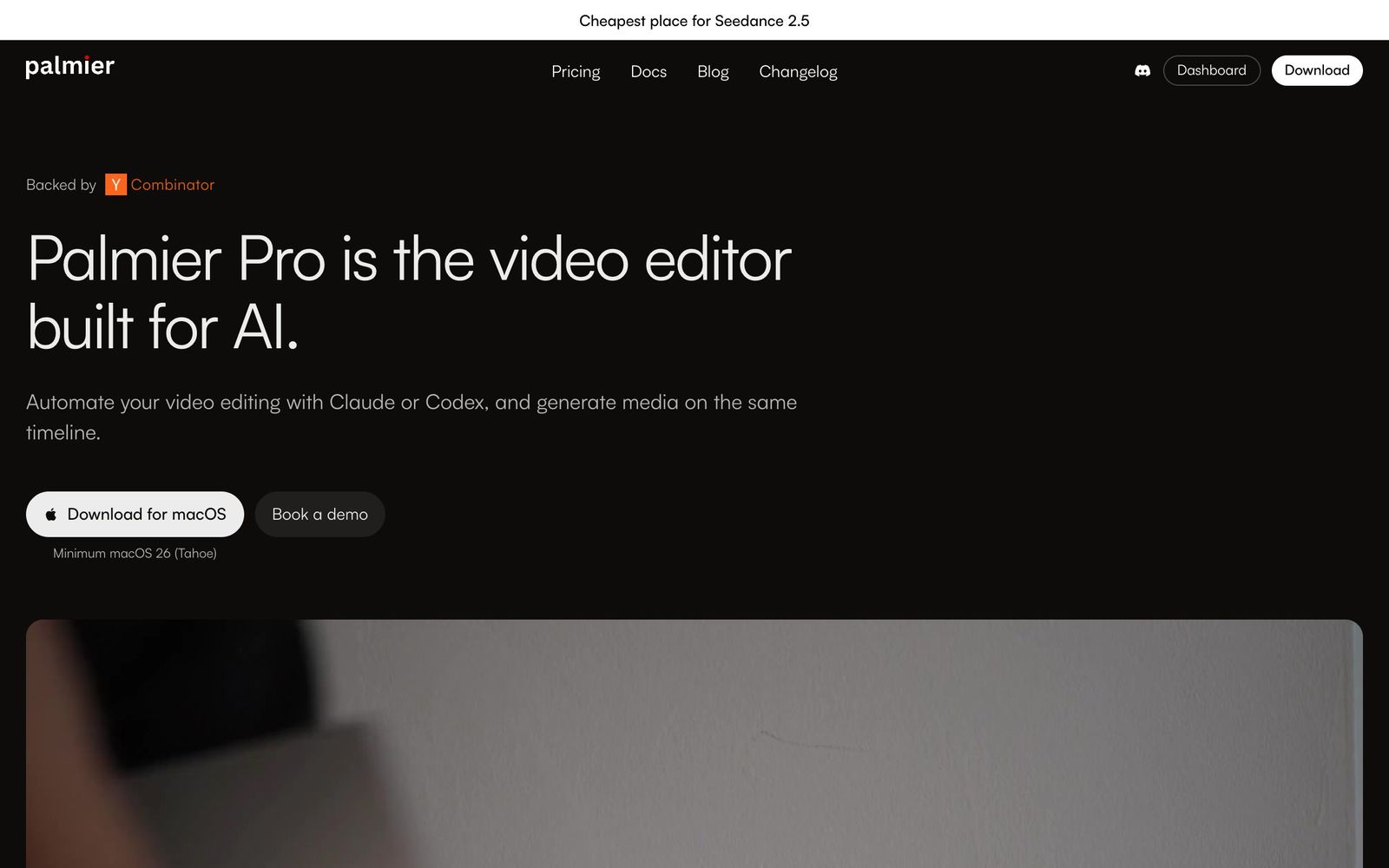
Our rating: 4.1/5. Fit for this job 4.0/5, ease of use 3.8/5, value for money 4.4/5.
Palmier Pro is a free, open-source Mac editor built to be run by AI agents: Claude Code, Codex or Cursor connect to it, inspect the project and edit the timeline. For Descript users who liked Underlord but want their own agent in charge, it's the most direct swap, and a finished edit can be saved as a reusable Skill.
It is a full editor (keyframes, colour, masks, multicam, local transcription, captions, remove silence) with XML out to Premiere, Resolve and Final Cut. It needs macOS 26 (Tahoe) or newer and is still pre-1.0 (0.12.0, 29 October 2026).
Standout feature: Claude, Codex or Cursor edit the timeline through a local connector, and a finished edit can be saved as a reusable Skill for the next video.
What's the difference between Palmier Pro and Descript? Palmier Pro is a full open-source Mac editor your own agent drives, with no media-hour cap. Descript is a transcript-first editor on desktop and the web with its own agent, recording and hour caps.
Palmier Pro pros:
- Free, open-source Mac editor (GPL-3.0) with 14,811 GitHub stars
- Your own agent edits the timeline over MCP, with no account needed
- Image, video, voice and music generation lands on the same timeline
- A full editor: multi-track timeline, keyframes, colour grading, masks and multicam
Palmier Pro cons:
- Mac only, and only on macOS 26 (Tahoe) or newer
- AI generation, cloud transcription and the built-in chat need a paid plan
Pricing: Free plan: the full Mac editor, with no account needed and no generation credits. Pro is shown at $29 a month (marked down from $49) with 5,000 credits a month.
Who it's for: Mac users on macOS 26 who edit with Claude Code, Codex or Cursor.
Choose Palmier Pro over Descript if: you want your own coding agent to drive a full, open-source editor on a recent Mac.
What's new in Palmier Pro: Version 0.12.0 (29 October 2026) added a headless mode that runs several projects at once, timeline history snapshots, caption presets with per-word styles and Kling V4.
Available for: Mac (macOS 26 or newer), driven by Claude, Codex or Cursor over MCP
#4 VEED: Best for subtitled social videos in the browser
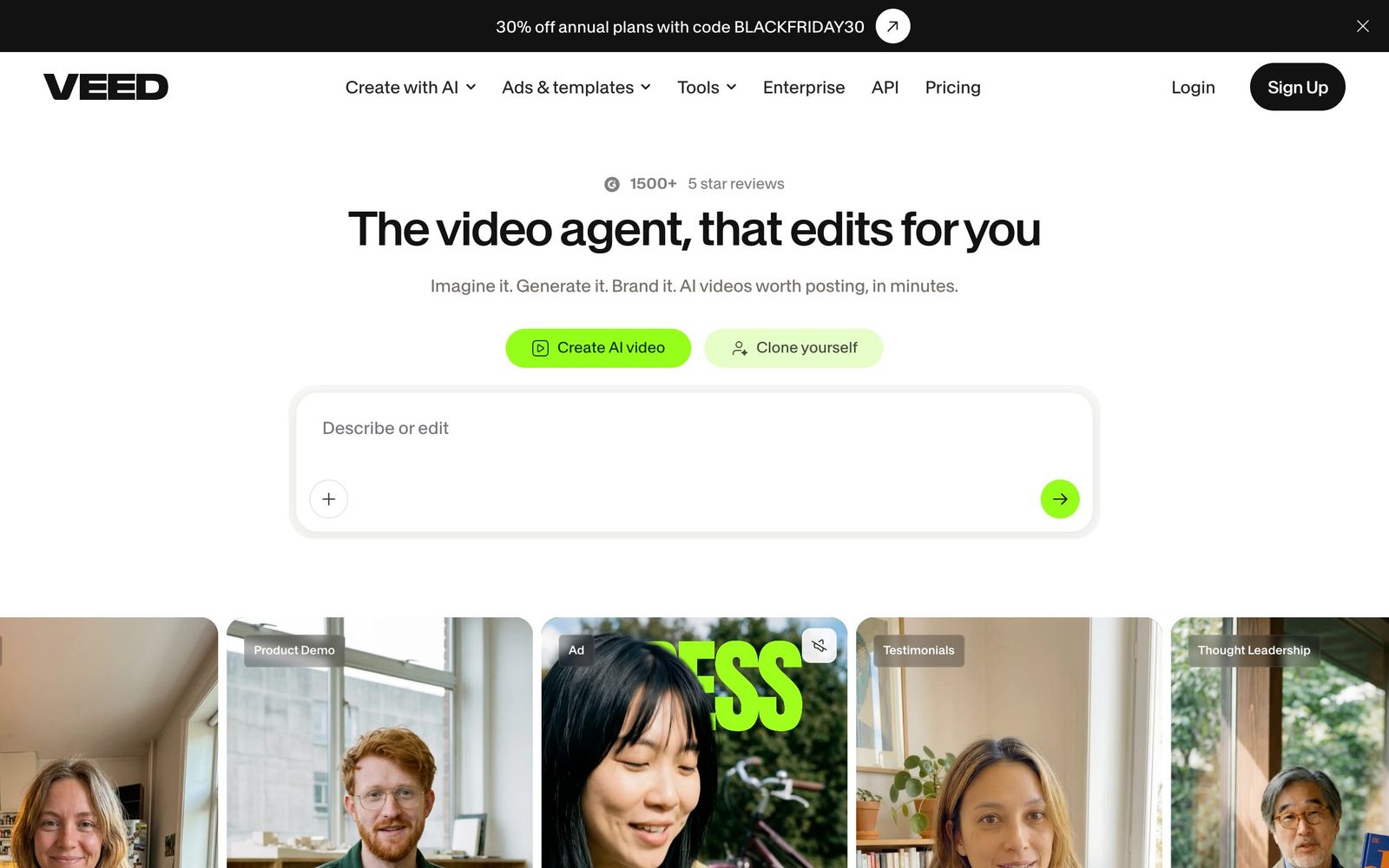
Our rating: 4.1/5. Fit for this job 3.8/5, ease of use 4.5/5, value for money 3.9/5.
VEED (veed.io) is an online video editor built around automatic subtitles, with templates, brand kits, AI avatars, dubbing and an AI clip generator. On 18 November 2026 it launched VEED AI, an agent that edits a social video from your footage or an idea.
For Descript users it's a sideways move: better for short subtitled posts, weaker for hour-long talk. Pricing is per editor, and reviewers in 2026 report hitting the paywall only at download, so test a full export first.
Standout feature: VEED AI (18 November 2026): upload footage or describe an idea and its agent edits a social video.
What's the difference between VEED and Descript? VEED is better for short, subtitled social videos and has phone apps. Descript is better for long talk, podcasts and transcript editing.
VEED pros:
- Easy browser editor with strong subtitles
- Avatars, dubbing and eye contact fix
- Brand kits
- iPhone and Android apps
VEED cons:
- Priced per editor, so teams pay per seat
- AI credits and translation minutes don't roll over
Pricing: Free plan with watermarked videos and 50 AI credits a month. Creator is $25 a month, or $12 a month billed yearly, per editor.
Who it's for: Marketers, social media managers and solo creators who publish short subtitled videos and work in the browser.
Choose VEED over Descript if: most of your output is short social video with burned-in subtitles.
What's new in VEED: VEED AI, a video editing agent for social videos, launched on 18 November 2026.
Available for: Web, iPhone and Android
Best Descript alternatives for podcast recording and production
If you used Descript for Rooms, its remote recorder, start here. Many podcasters split the workflow: record in one tool, edit in another.
#5 Riverside: Best for recording remote guests in studio quality

Our rating: 4.2/5. Fit for this job 4.4/5, ease of use 4.4/5, value for money 3.8/5.
Riverside records high-quality files for every participant locally, in up to 4K video and 48 kHz audio, then uploads them, so a shaky connection doesn't ruin the recording. It adds a text-based editor, a teleprompter, in-person multi-camera recording, live streaming and webinars. Magic Clips and Magic Audio use no credits.
The 14-day trial bills on day 15, and one November 2026 reviewer calls editing footage recorded elsewhere glitchy, so it's strongest when Riverside recorded the files.
Standout feature: Records every guest locally in up to 4K and 48 kHz, so remote interviews don't depend on the connection.
What's the difference between Riverside and Descript? Riverside is stronger at remote recording and has live streaming. Descript is stronger at editing and records your screen too.
Riverside pros:
- Studio-quality remote recording
- Text-based editor, Magic Clips and Magic Audio
- Teleprompter and in-person multi-cam
- Live streaming and webinars
Riverside cons:
- No free plan; the trial bills on day 15
- AI translation and B-roll spend credits
Pricing: No free plan, a 14-day trial. Pro is $35 a month, or $24 a month billed yearly.
Who it's for: Interview podcasters who record remote guests every week and care about audio quality first.
Choose Riverside over Descript if: recording remote guests well matters more than editing depth.
What's new in Riverside: Webinar Practice Mode (17 November 2026) and right-click menus in the editor (16 November).
Available for: Web, with recording in the browser and on phones
#6 Async (formerly Podcastle): Best for chat editing plus a podcast studio
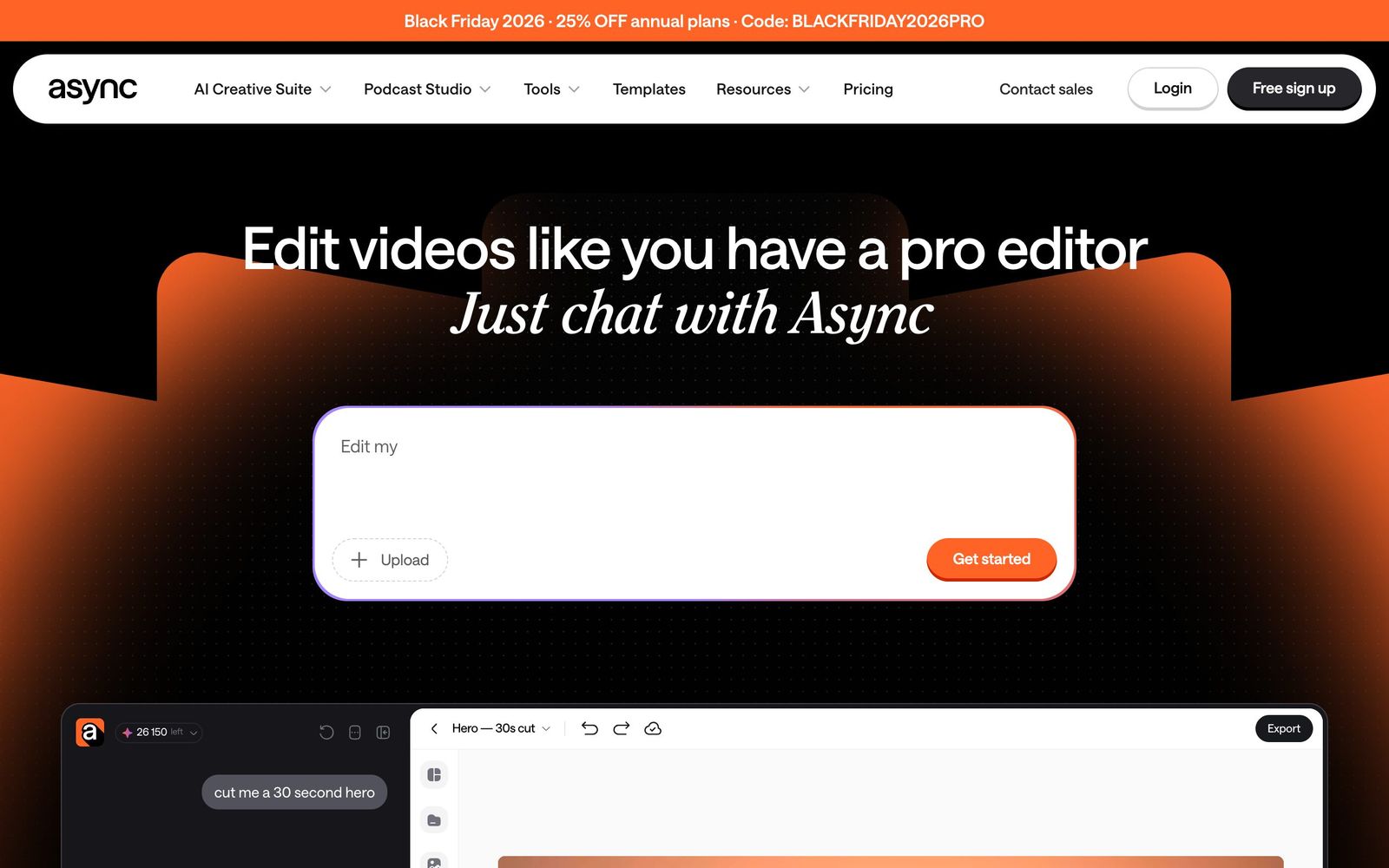
Our rating: 4.0/5. Fit for this job 4.0/5, ease of use 4.2/5, value for money 3.8/5.
Async is the new name of Podcastle (renamed on 28 January 2026; accounts, projects and billing stayed the same). It pairs a podcast recording studio with a chat-based video editor, and on 25 November 2026 it launched Async Motion: describe titles, lower thirds or overlays in chat and the AI makes them.
Trustpilot gives it 3.5 from 269 reviews; one reviewer (September 2026) says it renewed without a reminder.
Standout feature: Edit by chatting with an AI editor, plus recording, podcast tools and new chat-made motion graphics.
What's the difference between Async (formerly Podcastle) and Descript? Async edits by chatting and now makes motion graphics. Descript edits by transcript and caps media hours rather than chat requests.
Async (formerly Podcastle) pros:
- Chat-based video editing
- Recording and podcast tools
- Async Motion makes titles and overlays from a chat request
Async (formerly Podcastle) cons:
- Generation runs on monthly credits
- One Trustpilot reviewer (September 2026) mentions renewal without a reminder; another (August 2026) a refused refund
Pricing: Free sign-up. Essentials is $19.99 a month, or $11.99 billed yearly.
Who it's for: Podcasters who want recording and chat editing in one subscription.
Choose Async (formerly Podcastle) over Descript if: you want a podcast recorder and an editor you talk to in one subscription.
What's new in Async (formerly Podcastle): Async Motion launched on 25 November 2026; Podcastle renamed itself Async on 28 January 2026.
Available for: Web and iPhone
#7 Zencastr: Best for free remote recording and hosting
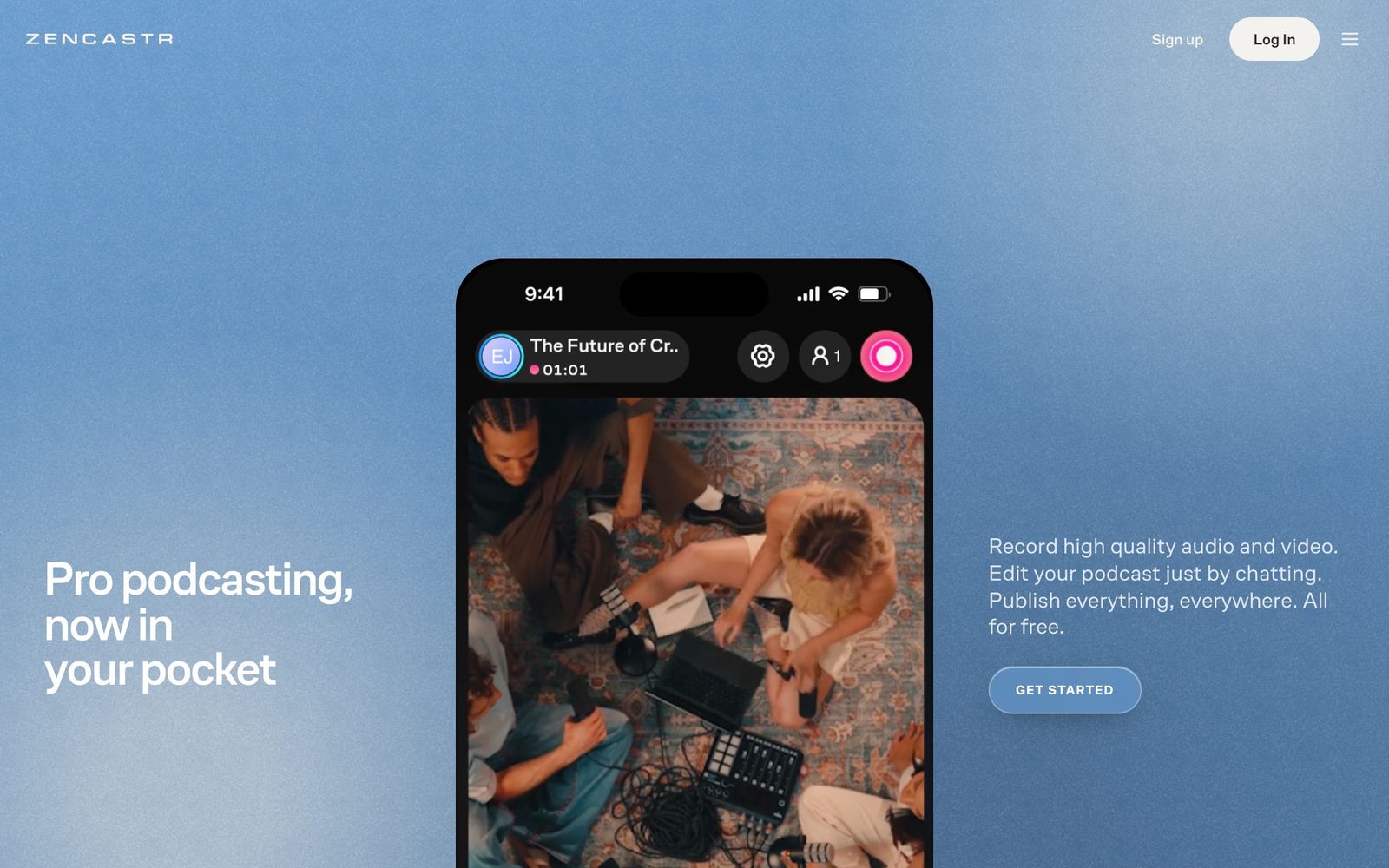
Our rating: 4.2/5. Fit for this job 3.7/5, ease of use 4.2/5, value for money 4.7/5.
Zencastr's free plan for individuals records with no time cap: 4K video and 48 kHz WAV audio, local recording with cloud backup and up to 6 participants, plus hosting and publishing to Spotify, Apple Podcasts and YouTube.
Editing happens by chatting with an AI Producer that removes pauses and filler words and writes show notes. It is lighter than Descript's editor, so many people record and host in Zencastr and edit elsewhere.
Standout feature: Free 4K remote recording and hosting, with editing by chatting to an AI Producer.
What's the difference between Zencastr and Descript? Zencastr records and hosts for free. Descript is the stronger editor but charges for recording time through its media-hour caps.
Zencastr pros:
- Free remote recording in 4K and 48 kHz
- Hosting and publishing included
- AI Producer removes pauses and filler words
- Rated 4.9 on the iPhone App Store
Zencastr cons:
- 6 participants on the free tier
- Few public reviews
Pricing: Free for individuals: unlimited recording and hosting, 4K video and 48 kHz audio for up to 6 people. Enterprise is custom.
Who it's for: Independent podcasters who want free recording and hosting and a light edit.
Choose Zencastr over Descript if: you want free remote recording and hosting and will edit the episode in another tool.
What's new in Zencastr: iOS 2.8 shipped on 19 November 2026.
Available for: Web, iPhone and desktop
Best Descript alternatives for removing ums, pauses and bad takes
If cleanup is the main thing you use Descript for, a dedicated cutter is faster and cheaper, and both of these hand the cut to a pro editor as an adjustable timeline.
#8 Gling: Best for removing bad takes for YouTubers
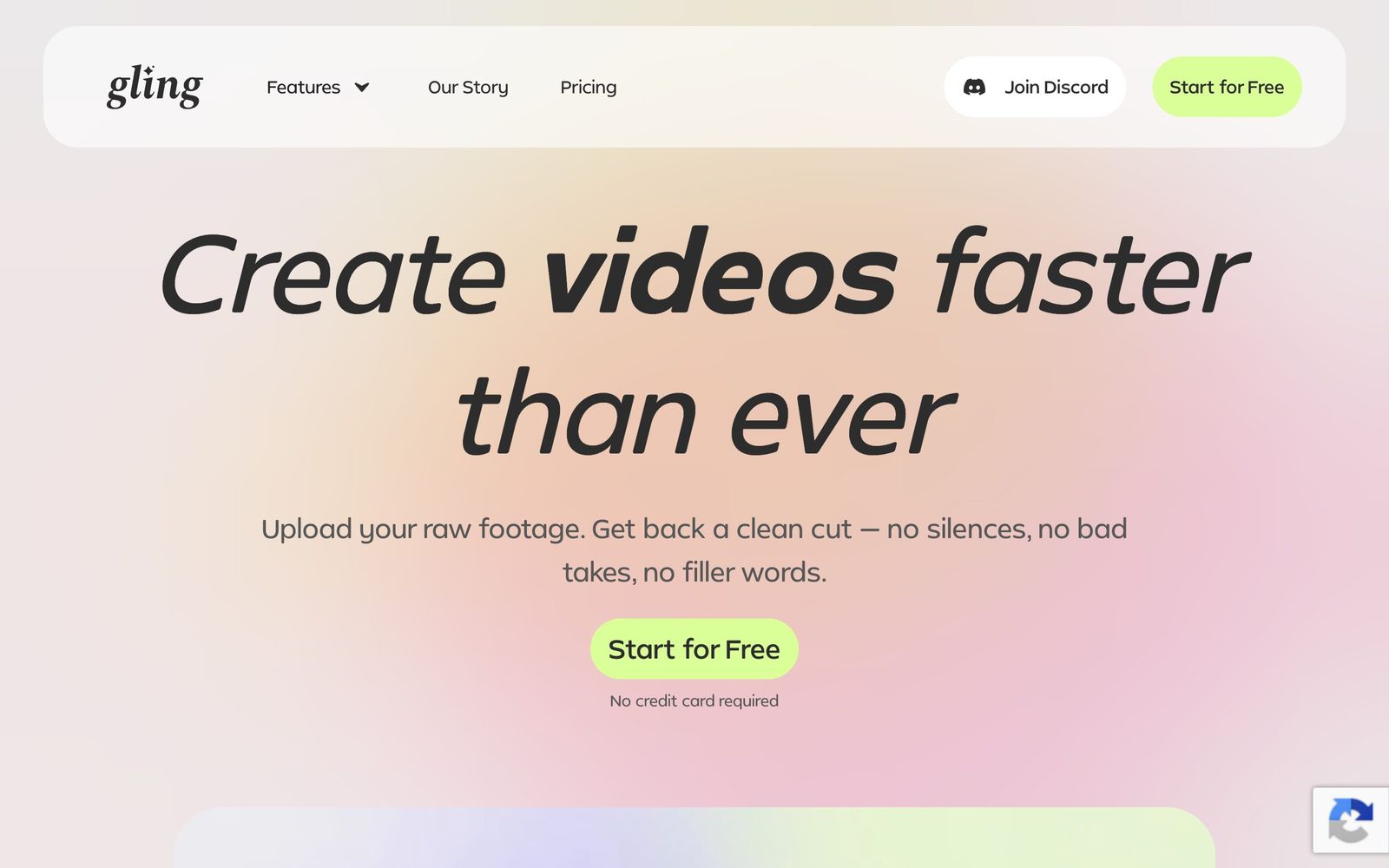
Our rating: 4.2/5. Fit for this job 4.3/5, ease of use 4.4/5, value for money 4.0/5.
Gling is built for creators who record a line three times and keep the best one. It finds the bad takes, removes silences and filler words, cleans noise, writes YouTube titles and chapters, and exports an editable timeline to Premiere Pro, Final Cut Pro or DaVinci Resolve.
Every plan caps AI-edited hours, and the free plan can't export to an editor.
Standout feature: Finds and removes bad takes (repeated attempts at a line), not only silences, then hands the cut to your editor.
What's the difference between Gling and Descript? Gling picks between takes and hands the cut to your editor. Descript edits by transcript inside its own editor.
Gling pros:
- Removes bad takes, silences and filler words
- Exports an editable timeline to Premiere, Final Cut or Resolve
- Captions with SRT export and auto zooms
- YouTube titles and chapters
Gling cons:
- Paid plans cap hours of edited media (10, 30 or 100 a month)
- Free exports are watermarked and can't go to an editor
Pricing: Free plan with 1 hour a month and watermarked exports. Plus is $20 a month, or $10 billed yearly, for 10 hours.
Who it's for: YouTubers who record many takes of each line and finish in a pro editor.
Choose Gling over Descript if: you record many takes of each line and finish in Premiere, Final Cut or Resolve.
What's new in Gling: No public changelog; the pricing page now also meters generated video from a link (undated, checked 26 November 2026).
Available for: Desktop app, with export to Premiere, Final Cut and DaVinci Resolve
#9 TimeBolt: Best for fast desktop jump cuts with no credits
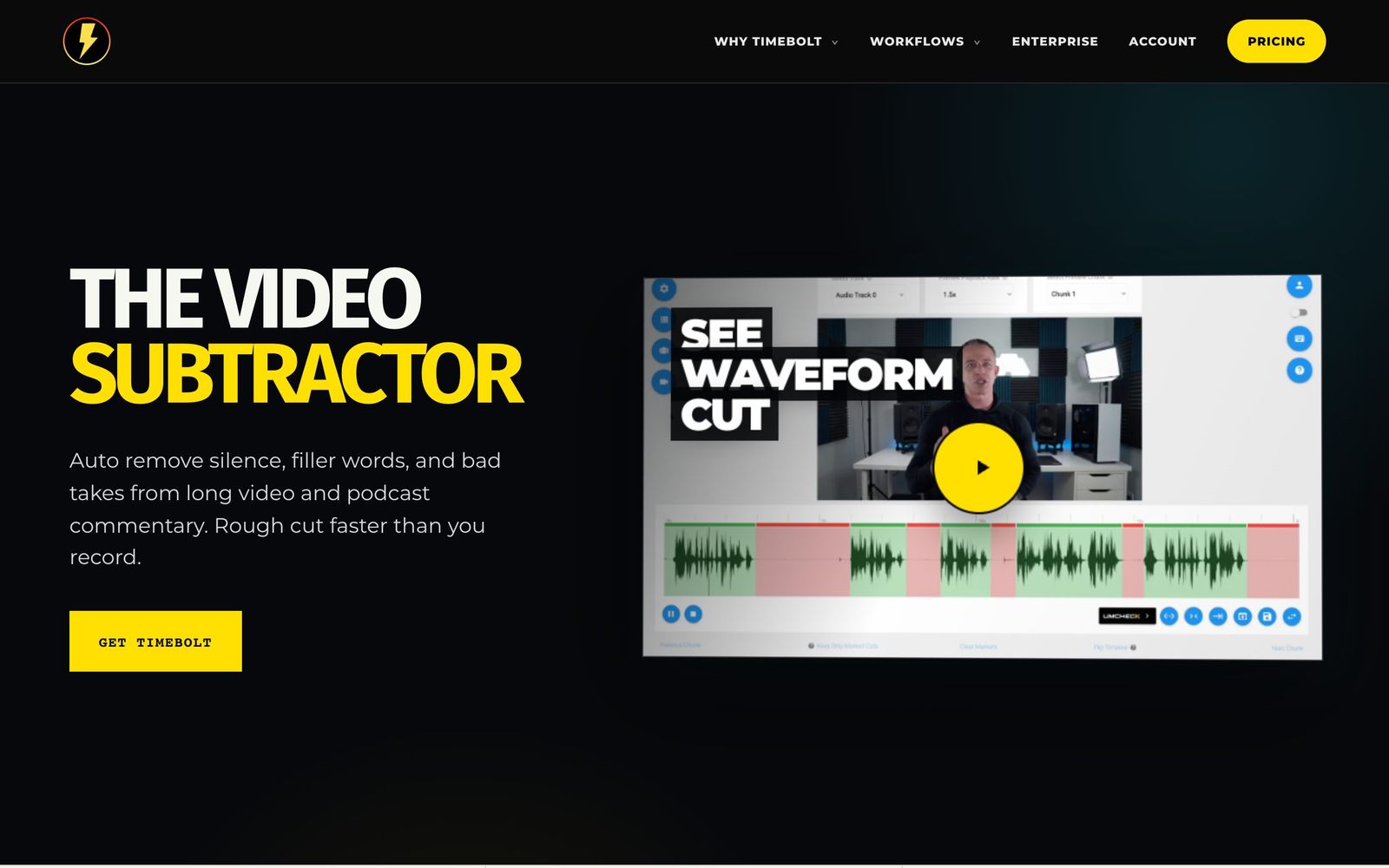
Our rating: 4.2/5. Fit for this job 4.1/5, ease of use 4.3/5, value for money 4.3/5.
TimeBolt is a Mac and Windows app that removes silences, filler words, repeats and bad takes, and claims to jump-cut an hour of video in 13 seconds. Transcription runs on your own computer with no per-minute fees, and a free 4K screen and camera recorder comes with it. The Lifetime licence has a 30-day money-back guarantee.
Standout feature: Fast jump cuts with free on-device transcription: no per-minute fees or credits.
What's the difference between TimeBolt and Descript? TimeBolt is faster, local and has no hour caps or credits. Descript is a full editor with recording and an agent.
TimeBolt pros:
- Very fast silence and filler removal
- Local transcription with no credits
- Lifetime licence option
- Free 4K screen and camera recorder
TimeBolt cons:
- Free exports are watermarked
- One licence covers 2 machines
Pricing: Free forever with watermarked exports. Pro is $17 a month, or $97 a year; Lifetime is $347 once.
Who it's for: People who batch long recordings and want the cleanup done in seconds on their own machine.
Choose TimeBolt over Descript if: you batch long recordings and want a one-time licence instead of a meter.
What's new in TimeBolt: Version 8.1.1 (November 2026) redesigned the multi-track editor, after on-device transcription for filler removal in 8.0 (October).
Available for: Mac and Windows, plus a local connector for AI agents
Best Descript alternatives for pro editors and research teams
If you outgrew Descript's timeline and need full finishing tools, or search hours of footage. All three edit by text (Resolve only in the paid Studio version).
#10 Adobe Premiere: Best for text-based editing in the industry standard
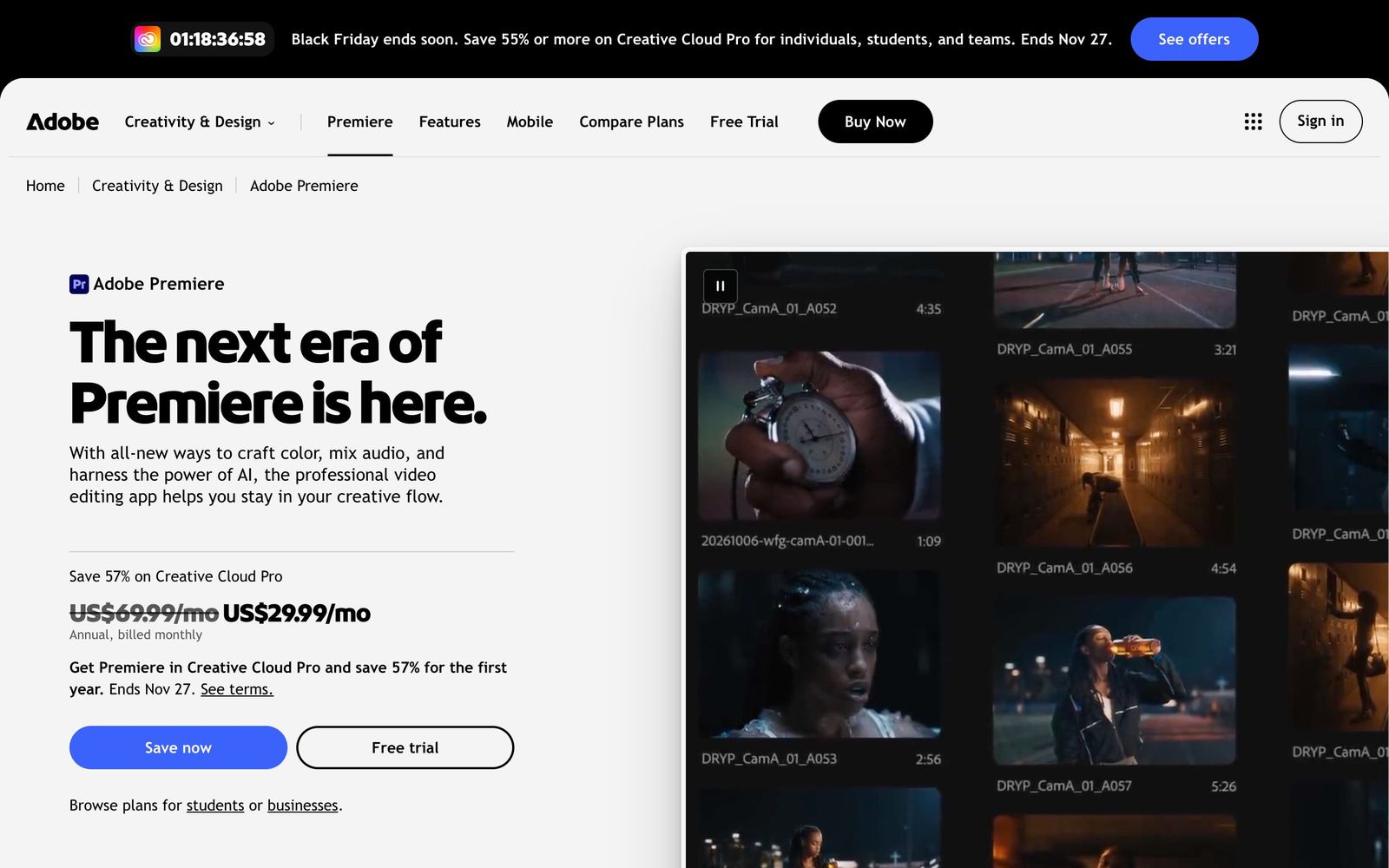
Our rating: 3.8/5. Fit for this job 4.0/5, ease of use 3.6/5, value for money 3.7/5.
Adobe Premiere (Adobe dropped "Pro" from the name in January 2026) has Text-Based Editing that trims and reorders clips like a document, and Separate Crosstalk, which splits two overlapping speakers into their own stems. Version 27.0 (10 November 2026) added Color Mode and an AI Assistant panel that assembles rough cuts.
Standout feature: The industry-standard timeline, now with Generative Extend, an AI Assistant panel and a Color Mode grading workspace.
What's the difference between Adobe Premiere and Descript? Premiere is a full pro editor with text editing built in. Descript is easier, records guests and screens, and meters media hours on top of per-seat pricing.
Adobe Premiere pros:
- Industry standard, with every pro feature
- Text-based editing and captions in 20+ languages
- Color Mode and one-click subject masking
- Generative Extend fills missing frames
Adobe Premiere cons:
- Annual commitment; full refund only within 14 days, and one reviewer reports an early termination fee
- Only 25 generative credits a month on the Premiere plan
Pricing: No free plan, a 7-day trial. The Premiere plan is $22.99 a month on an annual plan; Creative Cloud Pro adds 20+ apps.
Who it's for: Editors who deliver for clients and need the format everyone else uses.
Choose Adobe Premiere over Descript if: you edit for clients or collaborators who already work in Premiere.
What's new in Adobe Premiere: Premiere 27.0 (10 November 2026) added Color Mode, the AI Assistant panel and Separate Crosstalk. Adobe dropped "Pro" from the name in January 2026.
Available for: Windows, Mac and phones
#11 DaVinci Resolve: Best for free pro editing, colour and audio
Our rating: 4.0/5. Fit for this job 3.7/5, ease of use 3.4/5, value for money 5.0/5.
DaVinci Resolve's free version is a full professional editor: colour, Fusion effects and Fairlight audio, up to Ultra HD at 60 fps with no watermark. Fairlight covers audio editing, noise, levels and mixing for a podcast if you are willing to learn it.
Text-based editing and the AI tools need the paid Studio version, with no subscription. It runs on Mac, Windows and Linux, but it is hard to learn and heavy on slower computers.
Standout feature: A full professional editor (edit, colour, Fusion effects, Fairlight audio) free, with no watermark.
What's the difference between DaVinci Resolve and Descript? Resolve is a free pro editor with deep audio and colour. Descript is a simple transcript editor with recording built in.
DaVinci Resolve pros:
- A full professional editor, free
- Industry-leading colour grading
- One-time $295 for Studio
- Mac, Windows and Linux
DaVinci Resolve cons:
- Steep learning curve
- Text-based editing and AI tools need Studio
Pricing: Free version with no watermark up to Ultra HD at 60 fps. DaVinci Resolve Studio is $295 once.
Who it's for: Creators who want pro tools without a subscription and have time to learn.
Choose DaVinci Resolve over Descript if: you want pro tools without a subscription and can live with a learning curve.
What's new in DaVinci Resolve: Resolve 21.2 (4 November 2026) added faster rendering on M5 Pro and M5 Max Macs and new film looks; Resolve 21 added a Photo page and IntelliSearch.
Available for: Mac, Windows and Linux
#12 Reduct: Best for searching and cutting hours of transcribed footage
Our rating: 3.8/5. Fit for this job 3.8/5, ease of use 4.0/5, value for money 3.6/5.
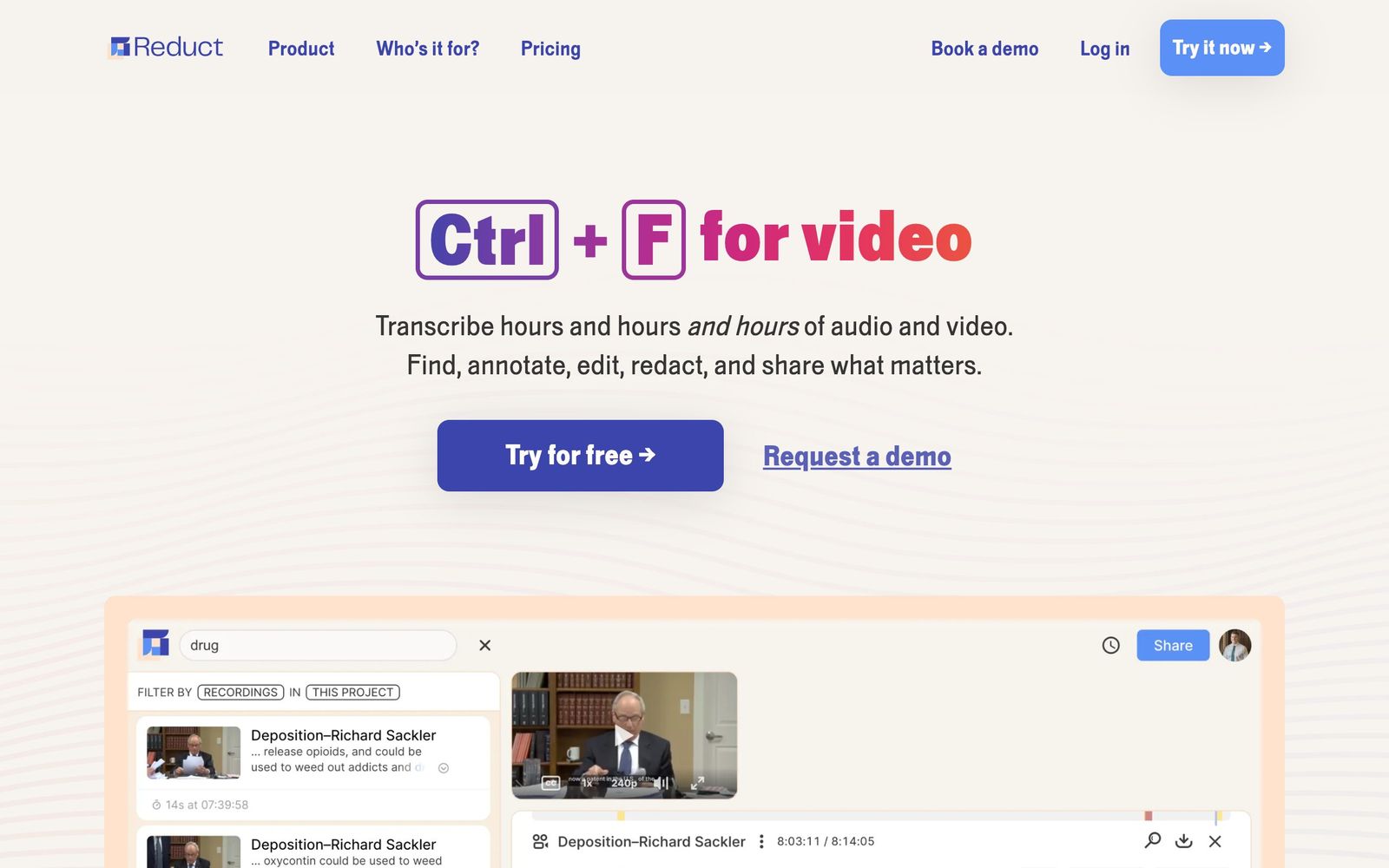
Reduct is transcript editing for teams with a lot of footage: transcription in 90+ languages, text-based editing, highlight reels and search across every project, which it calls Ctrl + F for video. Rough cuts export to Premiere Pro or Final Cut Pro, and Professional adds a multicam timeline and redaction.
Standout feature: Ctrl + F for video: search hours of transcribed footage across projects and export captioned clips by selecting text, in 90+ languages.
What's the difference between Reduct and Descript? Reduct is built for searching and quoting large footage libraries. Descript is built for producing a finished episode.
Reduct pros:
- Edit video by editing the transcript
- Highlights, labels and search across projects
- Redaction of personal data in video and audio (Professional)
- Rough-cut export to Premiere Pro or Final Cut Pro
Reduct cons:
- Built mainly for legal and research teams rather than creators
- Personal exports at 720p; 4K only on Enterprise
Pricing: No free plan; a 14-day trial includes 5 hours of transcription. Personal is $15 per editor a month, or $12 billed yearly; Professional is $50, or $40 billed yearly.
Who it's for: Research, legal and marketing teams who mine hours of interviews for quotes.
Choose Reduct over Descript if: you search many hours of interviews more than you publish episodes.
What's new in Reduct: No public changelog entry found since April 2026; the latest blog post is from 6 April 2026.
Available for: Web, with exports to Premiere Pro and Final Cut Pro and an API on Professional
Best Descript alternatives for social clips
If you use Descript mostly for creating content for social: short posts cut from long recordings.
#13 OpusClip: Best for ranked clips from long episodes
Our rating: 4.2/5. Fit for this job 3.9/5, ease of use 4.5/5, value for money 4.1/5.
OpusClip's ClipAnything takes a link or upload and returns ranked short clips for TikTok, Reels and Shorts, each with a Virality Score, animated captions in 20+ languages and reframing to 9:16, 1:1 or 16:9. OpusClip 4.0 (2 November 2026) added auto-edit for raw talking-head videos.
Free uploads are deleted after 3 days, and the Pro plan adds XML export, the scheduler and the API.
Standout feature: ClipAnything returns ranked short clips from one long video, each with a Virality Score, captions and reframing.
What's the difference between OpusClip and Descript? OpusClip only makes clips from a finished video. Descript edits the whole episode.
OpusClip pros:
- Fast, ranked clips from one upload or link
- Animated captions in 20+ languages
- Exports XML to Premiere Pro and DaVinci Resolve on Pro
- Social scheduler and API on Pro
OpusClip cons:
- Free exports carry a watermark and media expires after 3 days
- One Trustpilot reviewer waited over a day for a human reply; another lost paid credits after cancelling
Pricing: Free plan with 60 credits a month, a watermark and up to 1080p. Starter is $15 a month (monthly only); Pro is $29 a month, or $14.50 a month billed yearly.
Who it's for: Podcasters and creators who want many clips from each episode without editing them.
Choose OpusClip over Descript if: you want many clips from each episode without editing them yourself.
What's new in OpusClip: OpusClip 4.0 (2 November 2026) added auto-edit for raw talking-head videos, saved edit Recipes, Viral Hook and Motion Graphics.
Available for: Web, plus an API and a Claude connector
#14 CapCut: Best for free phone and desktop editing for trends
Our rating: 4.0/5. Fit for this job 3.5/5, ease of use 4.5/5, value for money 4.0/5.
CapCut, from ByteDance, is the free editor many creators already have on their phone: trend templates, auto captions, text to speech, a background remover and Seedance video generation, on the web, desktop, iPhone and Android.
Trustpilot gives CapCut 1.2 from 1,416 reviews, mostly about billing after cancelling and paywalls at the export screen.
Standout feature: Templates and ByteDance's own AI models, with Seedance generation included in Pro credits.
What's the difference between CapCut and Descript? CapCut is a free template-and-trend editor on every device. Descript is a transcript editor for long talk.
CapCut pros:
- Free, fast and familiar on phone and desktop
- Templates for trends
- Auto captions, text to speech and background remover
- Plugin for ChatGPT and Codex
CapCut cons:
- Pro paywalls can appear at the export screen
- Trustpilot score of 1.2 (1,416 reviews); the low reviews we read mention charges after cancelling
Pricing: Free plan with basic editing and free templates. Pro is $19.99 a month on the web; the app stores sell other plans.
Who it's for: Creators who make short trend-driven videos on the phone.
Choose CapCut over Descript if: your clips are short, trend-driven and made on a phone.
What's new in CapCut: The CapCut plugin is live in ChatGPT and Codex, and iOS 20.3.0 (24 November 2026) improved trimming.
Available for: Web, Windows, Mac, iPhone and Android
Best Descript alternative for screen recording and tutorials
If you used Descript to record your screen for tutorials and walkthroughs.
#15 Camtasia: Best for software tutorials and training
Our rating: 3.6/5. Fit for this job 3.6/5, ease of use 3.9/5, value for money 3.4/5.
Camtasia from TechSmith is built for tutorials and training: screen and camera recording with a full timeline editor, Camtasia Rev for quick edits with vertical layouts, Zoom cloud recording import, and VTT captions in and out.
Standout feature: Built for software tutorials and training: screen and camera recording with a full editor.
What's the difference between Camtasia and Descript? Camtasia is built for screen tutorials with a traditional timeline. Descript records screens too but edits by transcript.
Camtasia pros:
- Made for tutorials and training
- Screen and camera together
- Windows and Mac
- TechSmith rated 4.1 on Trustpilot
Camtasia cons:
- Free exports are watermarked
- Yearly billing only; one TechSmith reviewer found the upgrade options unclear
Pricing: The full editor is free with a watermark. Paid plans are billed yearly; watermark-free exports start at Essentials, $179.88 a year.
Who it's for: Trainers and course makers who record software walkthroughs.
Choose Camtasia over Descript if: you make software tutorials and want a full timeline built around screen recordings.
What's new in Camtasia: Camtasia 2026.2.3 (22 October 2026) added a choice of update timing.
Available for: Windows and Mac
How to choose the right Descript alternative
Every alternative to Descript fits a different part of content creation. Pick the best tool for the part of the job you do most. If you are also leaving another tool, we compared the Riverside, Gling, OpusClip and Premiere Pro alternatives the same way.
What do you record, and where?
Remote interviews need a recorder that saves each guest locally (Riverside, or Zencastr for free). Screen tutorials need a screen recording tool that captures the cursor and camera cleanly (Camtasia, or TimeBolt's free recorder).
Text editing or chat editing?
To keep deleting words in a transcript, pick a real script view: HyperFrames Studio's Script tab, Premiere's Text-Based Editing or Resolve Studio. To describe the edit instead, ChatCut and Async put chat first and Palmier Pro lets your own coding agent drive. HyperFrames Studio does both on the same project.
How many hours do you edit each month?
If you edit more than Descript's 10-hour Hobbyist allowance, the meter matters more than features: HyperFrames Studio (local exports), DaVinci Resolve and TimeBolt have no hour caps; Gling and Descript cap hours per tier.
Where do your videos end up?
If you're creating content for social, clips with captions and speaker framing come from HyperFrames Studio or OpusClip. For designed titles, charts and motion graphics, HyperFrames. For subtitled social posts, VEED. For client delivery, Premiere.
How we compared
Every tool on this list was scored on three things:
- Talk-driven editing. How well its AI-powered editing tools transcribe, handle text-based video editing, remove fillers and pauses, clean background noise and keep audio quality high.
- Reliability and control. Whether edits land where you expect, whether AI results can be fixed by hand, and whether projects leave the tool in a format another editor opens.
- Value. Media-hour and credit caps per tier, the free plan, the monthly list price, and how well the tool handles long video files.
User complaints. We read recent reviews on Trustpilot, Product Hunt and the App Store and say when a complaint comes from a single review, with its date when it is old. Some review sites (G2, Capterra) blocked automated reading, so their scores are not quoted.
Ratings. Each tool gets three scores out of 5: fit for the job this page is about, ease of use, and value for money (free plan, entry price, watermarks and caps). The overall rating is their average. The scores are our judgment from the sources above, not a lab benchmark.
The films. The film near the top was made with HyperFrames for this page. The script-editing film in the HyperFrames section is from HeyGen's own launch post. The cover uses each product's own logo and a still of its own website.
Conclusion
For podcasters and talking-head creators, HyperFrames Studio is the strongest Descript alternative: transcript editing, an agent that finishes the edit, a multicam podcast edit and clips with the speaker kept in frame, with no media-hour cap on your computer. Pair it with Riverside or Zencastr if you record remote guests.
If cleanup is all you need, Gling and TimeBolt are faster and cheaper than any full editor; if you deliver for clients, Premiere is the format they expect, and DaVinci Resolve gives you the same depth free. Descript is still a good editor, with strong AI features and video editing features for talk; leave it when the meter, the credits or the bugs cost more than the convenience. Try HyperFrames Studio free, and the lessons walk through your first edit.
Edit your next video by its script, free
Frequently asked questions
What is the best Descript alternative?
HyperFrames Studio is the best Descript alternative for most creators: it edits by transcript or by asking an AI agent, cuts multicam podcasts to the speaker, and has no media-hour cap on your computer. Riverside is the best pick for recording remote guests, and Gling for removing bad takes.
Is there a free Descript alternative?
Yes. HyperFrames Studio is free to start and exports without limits on your computer, DaVinci Resolve's free version is a full professional editor with no watermark, and Zencastr records and hosts podcasts free. Descript's own free plan covers 1 media hour a month at 720p.
Which Descript alternatives keep text-based editing?
HyperFrames Studio (the Script tab), Adobe Premiere (Text-Based Editing), Riverside's editor, Gling's transcript trimmer, Reduct and DaVinci Resolve Studio all let you edit video through the transcript. ChatCut, Async and Zencastr edit by chat instead.
What is the best Descript alternative for podcasts?
HyperFrames Studio for editing (multicam edit, noise clean-up, per-speaker captions and show notes) and Riverside or Zencastr for recording remote guests. HyperFrames imports Riverside XML directly, so recording in one and editing in the other is a common setup.
Which tool is best for turning podcast episodes into clips?
OpusClip ranks clips from a finished episode and reframes them for TikTok, Reels and Shorts. HyperFrames Studio makes vertical clips from the episode you edited in it and keeps the speaker in frame, so the clips match the show's captions and look.
What happens to my Descript projects if I switch?
Export your timelines first: Descript exports to Premiere, Resolve and Pro Tools (EDL, AAF, FCPXML, with native .prproj in beta). Its project files don't open in other editors, so export before you cancel.
Which Descript alternative is best for screen recording tutorials?
Camtasia is built for software tutorials and training, with screen and camera recording and a full editor, and TimeBolt includes a free 4K screen recorder. HyperFrames Studio edits and captions what they record.
Can any of these replace Descript's AI voice?
HyperFrames Studio has free voices in the app, plus HeyGen Voice 1 and a clone of your own voice. ChatCut includes one voice clone on its free plan, and Palmier Pro generates voiceovers with ElevenLabs on its paid plan.
Can I create a video without recording anything?
Yes. Describe the video and HyperFrames Studio's agent builds it with kinetic type, charts, maps and a voiceover, or paste a video you love and make your own version. Descript, Riverside and the other editors here need a recording to start from.
Is HyperFrames cheaper than Descript?
For most creators, yes. HyperFrames Studio is free to start, with no media-hour cap and no watermark on exports from your computer. Descript's Hobbyist is $24 a month ($16 billed yearly) for 10 media hours.
What is the best Descript alternative for transcription?
HyperFrames Studio transcribes with speaker names free once you sign in, and runs local transcription in 25 languages. TimeBolt transcribes on your own computer with no credits. Reduct transcribes in 90+ languages and searches across every project.
Can I import a Riverside recording into another editor?
Yes. HyperFrames Studio's podcast edit imports Riverside XML along with Final Cut XML, and every editor here accepts the separate audio and video files Riverside downloads.
If remote recording quality matters most, which should I try first?
Riverside. It records every guest locally in up to 4K and 48 kHz, so a weak connection doesn't spoil the file. Zencastr records at the same quality free for up to 6 people.
Is Descript worth it if I only edit a few videos a month?
Its free plan covers 1 media hour a month at 720p, which is enough to try it. If you publish a couple of short videos a month, a free tool (HyperFrames Studio, DaVinci Resolve or CapCut) will usually cover you without paying.
Can I edit Descript-style from Claude Code or Codex?
Yes. HyperFrames Studio has Claude Code, Codex and 7 other outside agents built in. ChatCut ships plugins for Claude Code and Codex, Palmier Pro is a Mac editor those agents drive, and Descript has its own connector for AI agents. See how to make videos with Claude Code.
Does any Descript alternative work on a phone?
Riverside, Zencastr and Async have iPhone apps for recording, and CapCut and VEED edit on iPhone and Android. HyperFrames Studio runs on Mac, Windows, Linux and the web, not as a phone app.
Is HyperFrames free?
Yes, free to start: HyperFrames Studio is a free download, and the open-source engine behind it is free, with 90,000+ GitHub stars. Pro is $25 a month for more (pricing).

Written by Ular Kimsanov
Ular Kimsanov works on HyperFrames at HeyGen, the free, open-source tool where AI agents make videos, and writes about making videos with AI agents. Prices and plans on this page were checked on 26 November 2026.